

Creases Are There in Cricket
🏁 Introduction
Cricket is not just a sport in India — it’s an emotion. From gully matches in the streets to roaring stadiums during the IPL, every Indian knows the thrill of a close run-out or a bowler’s no-ball.
But have you ever noticed those white lines drawn around the pitch and wondered what they really mean? Those lines are called creases, and they play a massive role in how every ball, run, and wicket is decided.
In simple terms, creases are the boundaries that define fair play in cricket. They decide whether a batsman is safe, whether a bowler has bowled legally, or whether a wicketkeeper can stump a batter.
So, let’s dive deep and understand — how many creases are there in cricket, what each type does, and why they’re so important.
🏏 What Is a Cricket Pitch and Why Creases Matter
Before we talk about creases, let’s get the basics right.
A cricket pitch is a 22-yard-long (20.12 meters) rectangular strip located in the center of the field. It’s where all the action happens — bowling, batting, and dismissals.
Creases are lines marked on the pitch that help define:
- The bowler’s position for delivery
- The batsman’s safe area while running
- The umpire’s decisions like no-ball or run-out
In short, without creases, cricket would be pure chaos!
🧭 Types of Creases in Cricket
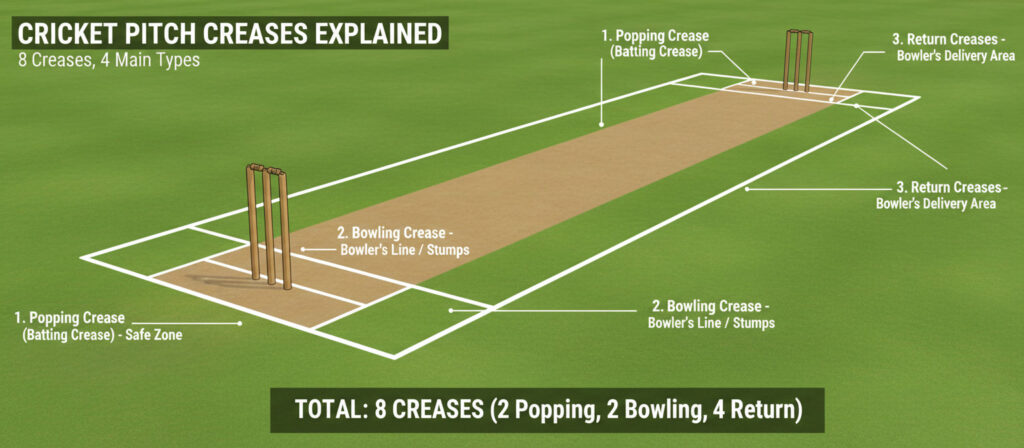
There are 4 main types of creases marked on a cricket pitch.
Each has a unique role and is placed at specific distances.
Let’s break them down one by one.
1️⃣ Bowling Crease
Definition:
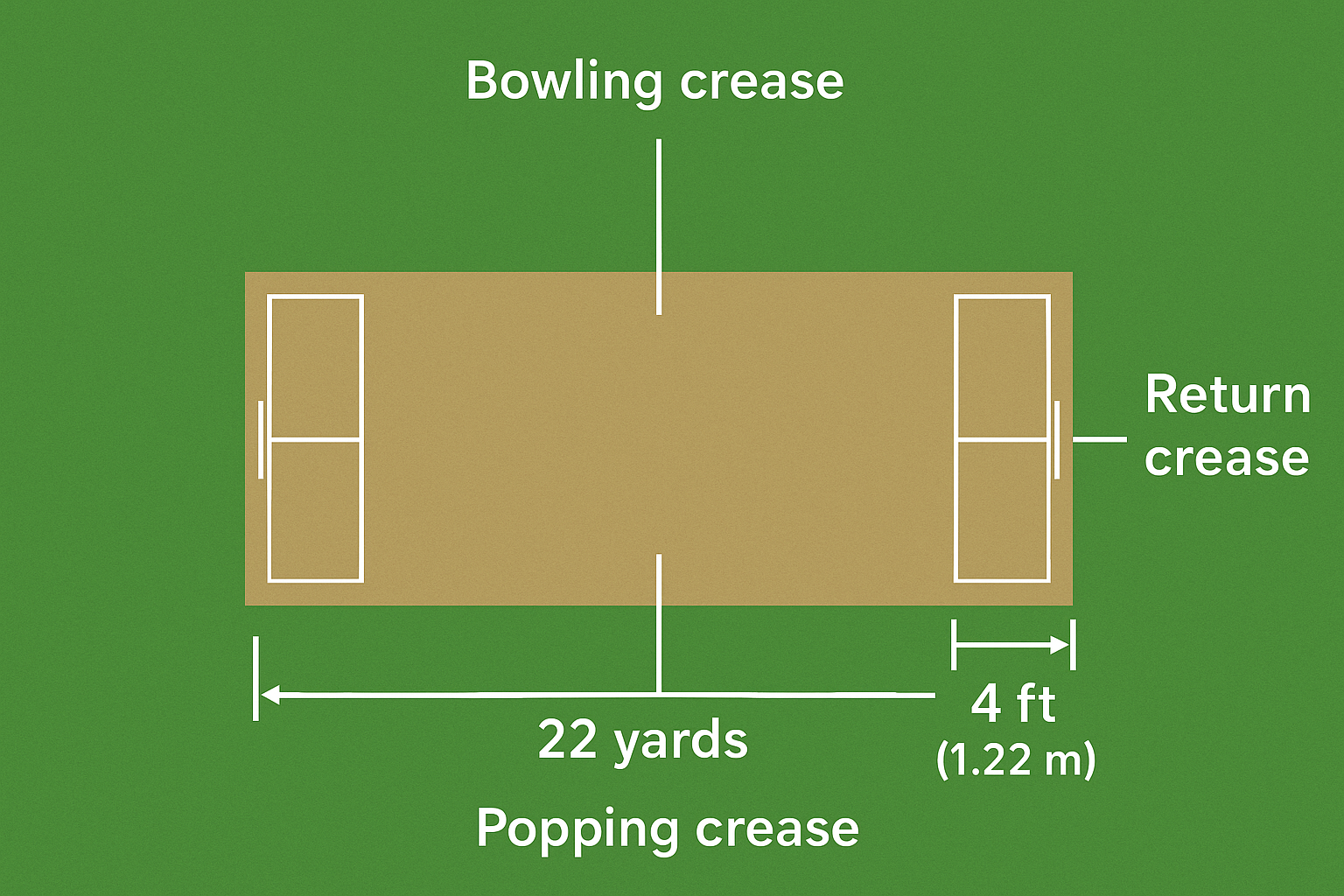
The bowling crease is the main line on which the stumps are placed. It’s drawn straight across the pitch, 8 feet 8 inches (2.64 meters) long.
Position:
Each set of wickets stands right in the middle of this line.
Use in the Game:
- It marks the area where the bowler must deliver the ball.
- If the bowler’s front foot crosses this line, it’s called a no-ball.
- It acts as the reference point for measuring the popping crease.
Example:
Remember when Jasprit Bumrah overstepped in the 2017 Champions Trophy final against Pakistan? That delivery was declared a no-ball because his front foot landed ahead of the bowling crease.
That one overstepping changed the momentum — showing how crucial this line is.
2️⃣ Popping Crease
Definition:
The popping crease is drawn 4 feet (1.22 meters) in front of the bowling crease on both sides of the pitch.
It’s one of the most important creases in cricket because it defines whether a batsman is safe or out.
Use in the Game:
- When a batsman’s bat or foot is behind the popping crease, they are considered “safe.”
- If they are outside it when the ball hits the stumps — it’s run-out or stumped.
- The bowler’s front foot must land behind the popping crease when delivering the ball.
Example:
Think of MS Dhoni’s lightning-fast stumpings — the popping crease is his best friend!
If the batsman’s bat or foot isn’t grounded behind it, Dhoni’s quick hands do the rest.
3️⃣ Return Crease
Definition:
The return crease is a pair of lines drawn perpendicular to the bowling crease, extending behind the stumps.
Position:
- They are drawn 4 feet 4 inches (1.32 meters) on each side of the middle stump.
- They extend at least 8 feet (2.44 meters) behind the bowling crease.
Use in the Game:
- It restricts the side movement of the bowler during delivery.
- The bowler’s back foot must remain inside the return crease.
- If the bowler’s back foot touches or crosses outside this crease — it’s a no-ball.
Example:
Spinners like Ravichandran Ashwin often go close to the return crease to get extra angle. But if their back foot crosses it, the delivery becomes illegal.
4️⃣ The Pitch’s Central Crease Setup
To summarize:
| Crease Type | Distance/Position | Key Purpose |
|---|---|---|
| Bowling Crease | Base line for stumps | Defines delivery zone |
| Popping Crease | 4 ft in front of bowling crease | Run-out / no-ball decisions |
| Return Crease (2 lines) | Perpendicular to bowling crease | Controls bowler’s movement |
So technically, there are 4 creases per end, making 8 creases total on a cricket pitch (since both sides are identical).
🧱 How Creases Are Marked and Maintained
Ever noticed how clean and straight those lines look even after hours of play?
Here’s how ground staff make it happen:
- Marking Material: Traditionally, creases are drawn using chalk or white paint. In modern stadiums, eco-friendly marking sprays are used.
- Laser Alignment: Some international venues use laser-guided marking systems for perfect accuracy.
- Pitch Rolling: Before marking, the surface is rolled flat to ensure even bounce and proper line visibility.
- Maintenance: After every innings, creases are repainted to maintain visibility for umpires and TV viewers.
Without clear creases, DRS and Hawk-Eye technology can’t function accurately!
⚖️ Importance of Creases in Cricket Laws
According to the Marylebone Cricket Club (MCC) Laws of Cricket, creases define nearly every decision in the game:
| Law | Description | Related Crease |
|---|---|---|
| Law 35 | Bowled dismissal | Bowling crease |
| Law 36 | Leg before wicket | Bowling crease reference |
| Law 38 | Run-out | Popping crease |
| Law 41 | Fair delivery | Bowling + Return creases |
| Law 39 | Stumped | Popping crease |
So you can see — creases literally decide everything, from whether a wicket is legal to whether a batsman survives a close call.
⚡ Real Match Examples Where Creases Changed the Game
- MS Dhoni vs Bangladesh (T20 World Cup 2016)
Dhoni ran out Mustafizur Rahman on the last ball — the popping crease decided India’s victory! - Jasprit Bumrah’s No-Ball (2017 Champions Trophy Final)
His overstep over the bowling crease cost India a wicket and shifted momentum to Pakistan. - Ashwin’s ‘Mankad’ Dismissal (IPL 2019)
The popping crease was central to controversy when Jos Buttler was run out for leaving too early. - Ben Stokes’ Dive in 2019 World Cup Final
His bat crossing the popping crease before a throw ensured he wasn’t run out in that historic match.
These moments show that a few inches around the crease can change cricketing history.
🧩 Common Myths About Creases
Let’s bust a few myths most fans believe:
❌ Myth 1: There are 5 creases in cricket.
✅ Truth: There are 4 creases per end — bowling, popping, and two return creases.
❌ Myth 2: Only batsmen use the popping crease.
✅ Truth: Both batsmen and bowlers depend on the popping crease for safety and legality.
❌ Myth 3: Creases differ in T20s, ODIs, and Tests.
✅ Truth: The dimensions remain the same across all formats.
🧠 Fun Facts About Creases in Cricket
- The word “crease” originates from the Old English word crisan meaning “to bend or fold.”
- Early cricket (before 1760) used scratched lines instead of painted ones!
- The first recorded “crease no-ball” was in 1804 in England.
- Crease dimensions have remained unchanged since 1969 under MCC laws.
- In 3D replays, the popping crease is often projected digitally for accuracy.
🔍 FAQs (Ready for Schema Markup)
❓ How many creases are there in cricket?
There are 4 creases per end — one bowling crease, one popping crease, and two return creases — making 8 in total on a cricket pitch.
❓ Which crease is used for run-out and stumping?
The popping crease determines whether a batsman is safe or out in run-outs and stumpings.
❓ What happens if a bowler steps over the crease?
If the bowler’s front foot lands beyond the bowling crease, it’s declared a no-ball.
❓ Are the creases different in Test and T20 cricket?
No, the crease dimensions and laws are the same in all cricket formats.
❓ Who decides if the bowler crosses the crease?
The on-field umpire, often with the help of technology (front-foot cameras), makes that call.
